
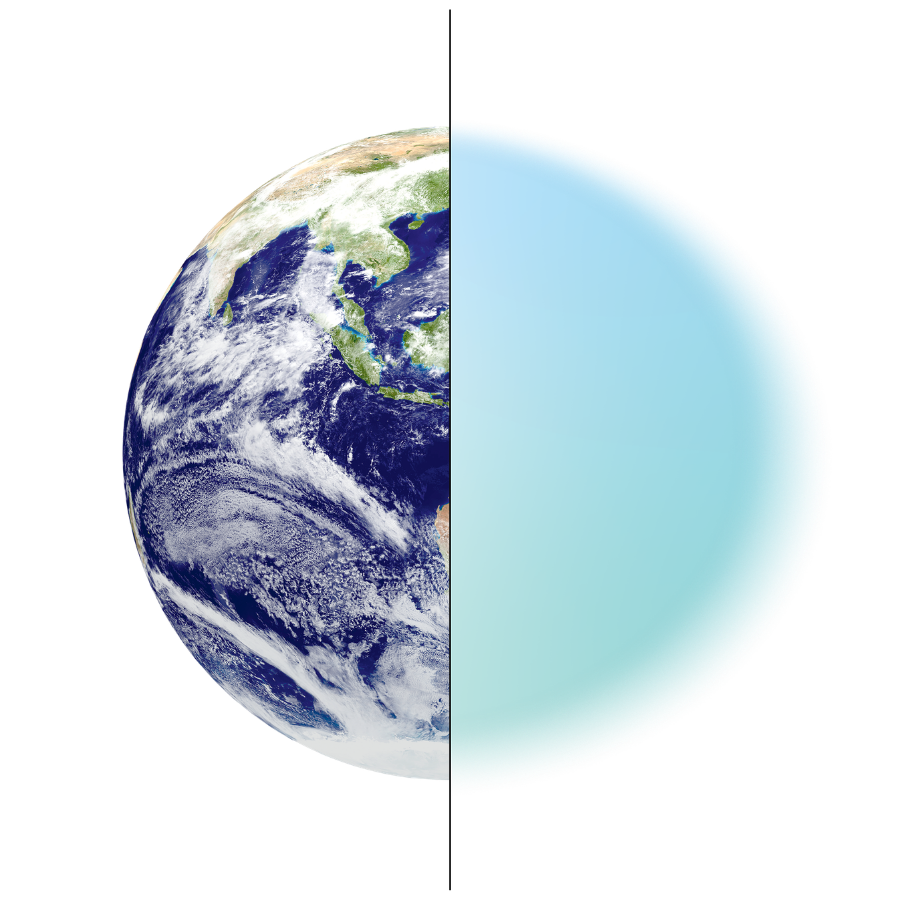

Exploring Climate Cooling
This £56.8m programme aims to build a robust evidence base to explore – with independent oversight – if climate cooling approaches could ever be feasible, scalable, safe, and governable.
Programme oversight + governance
We’re committed to responsible stewardship, transparency, accountability + good governance. All funded research in this programme must comply with the following governance principles:
- Deliver valuable + transformational knowledge. We aim to select and design for research that will address the most pressing critical scientific questions surrounding approaches for actively cooling the climate.
- Minimise risk. All experiments should be designed to reduce direct risk as far as possible.
- Engage with, and respect key communities.
- Communicate proactively and be transparent, open, and honest at both the programme and project level, including around levels and sources of funding, intentions, how the research is conducted, outputs, and impacts.
- Be cognisant of the broader implications of research + integrate systems thinking into research on approaches for actively cooling the climate.
- Learn, adapt and be responsive. Success will require a willingness to adapt to lessons learned during the programme and to changing circumstances.
Our goal is to build the open and objective scientific knowledge base the world needs to make better-informed decisions.
To ensure this, all our funded teams have signed a binding Intellectual Property (IP) Pledge. This legal commitment ensures:
-
All experimental data is made public for scrutiny by the global scientific community.
-
All patents are free for research. Any team member must provide a royalty-free licence for anyone to use their patents for research purposes.
Oversight Committee
To ensure rigorous and responsible governance, this programme benefits from an independent Oversight Committee composed of international experts and co-chaired by Professors Piers Forster and Jessica Seddon. The Committee advises ARIA leadership and plays a crucial role in scrutinising outdoor experiment plans, providing expert recommendations, and may advise against funding experiments unless certain modifications are made. While ultimate funding decisions rest with ARIA, the Oversight Committee has the authority to comment publicly and independently on experiment funding decisions and on other matters related to the programme and the wider field.
The committee focuses on:
-
Supporting effective oversight of the programme's outdoor experiments and guiding transparent communication of findings.
-
Shaping international norms and standards for the responsible governance of such experiments.
-
Contributing constructively to the wider international discussion on potential governance mechanisms for climate cooling approaches.
Learn more about the Committee's remit, members, and work

Ivan Jayapurna
Programme Director
Ivan joined ARIA from the University of California, Berkeley, with a PhD in materials science and engineering. While studying, Ivan co-led several tech spinout efforts, was twice funded by the National Science Foundation I-Corps, and co-founded a technical consultancy for biotech startups.

Alex Smith
Programme Specialist
Alex is a project management professional with experience in complex transformations. He recently streamlined national public service infrastructure for the Nursing and Midwifery Council and has led strategic initiatives at the London School of Economics, including delivering programmes, establishing governance and replacing legacy systems. Alex supports ARIA as an operating partner from Pace.
José Videira
Technical Specialist
José has been working in deeptech startups since the age of 15, with a core interest in materials integration and manufacturing resilience. He spent 8 years in a startup he co-founded, taking a dual-use material technology from TRL 0 to 6, and driving the deployment of physics-based AI/ML into production lines. He has a PhD in solid state physics from Imperial College London.
Ivan Jayapurna
Programme Director
Ivan joined ARIA from the University of California, Berkeley, with a PhD in materials science and engineering. While studying, Ivan co-led several tech spinout efforts, was twice funded by the National Science Foundation I-Corps, and co-founded a technical consultancy for biotech startups.
Alex Smith
Programme Specialist
Alex is a project management professional with experience in complex transformations. He recently streamlined national public service infrastructure for the Nursing and Midwifery Council and has led strategic initiatives at the London School of Economics, including delivering programmes, establishing governance and replacing legacy systems. Alex supports ARIA as an operating partner from Pace.
José Videira
Technical Specialist
José has been working in deeptech startups since the age of 15, with a core interest in materials integration and manufacturing resilience. He spent 8 years in a startup he co-founded, taking a dual-use material technology from TRL 0 to 6, and driving the deployment of physics-based AI/ML into production lines. He has a PhD in solid state physics from Imperial College London.
Resources
We prioritise transparency, public engagement, and risk minimisation. Project teams planning an outdoor experiment must navigate a formal, multi-stage approval process. This ensures no funding for an outdoor experiment is released without rigorous technical analysis and meaningful community engagement. Here are the key stages:
The Creator experience
What you can expect as an ARIA R&D creator
Applicant guidance
Discover the process of applying for ARIA funding and find key resources